
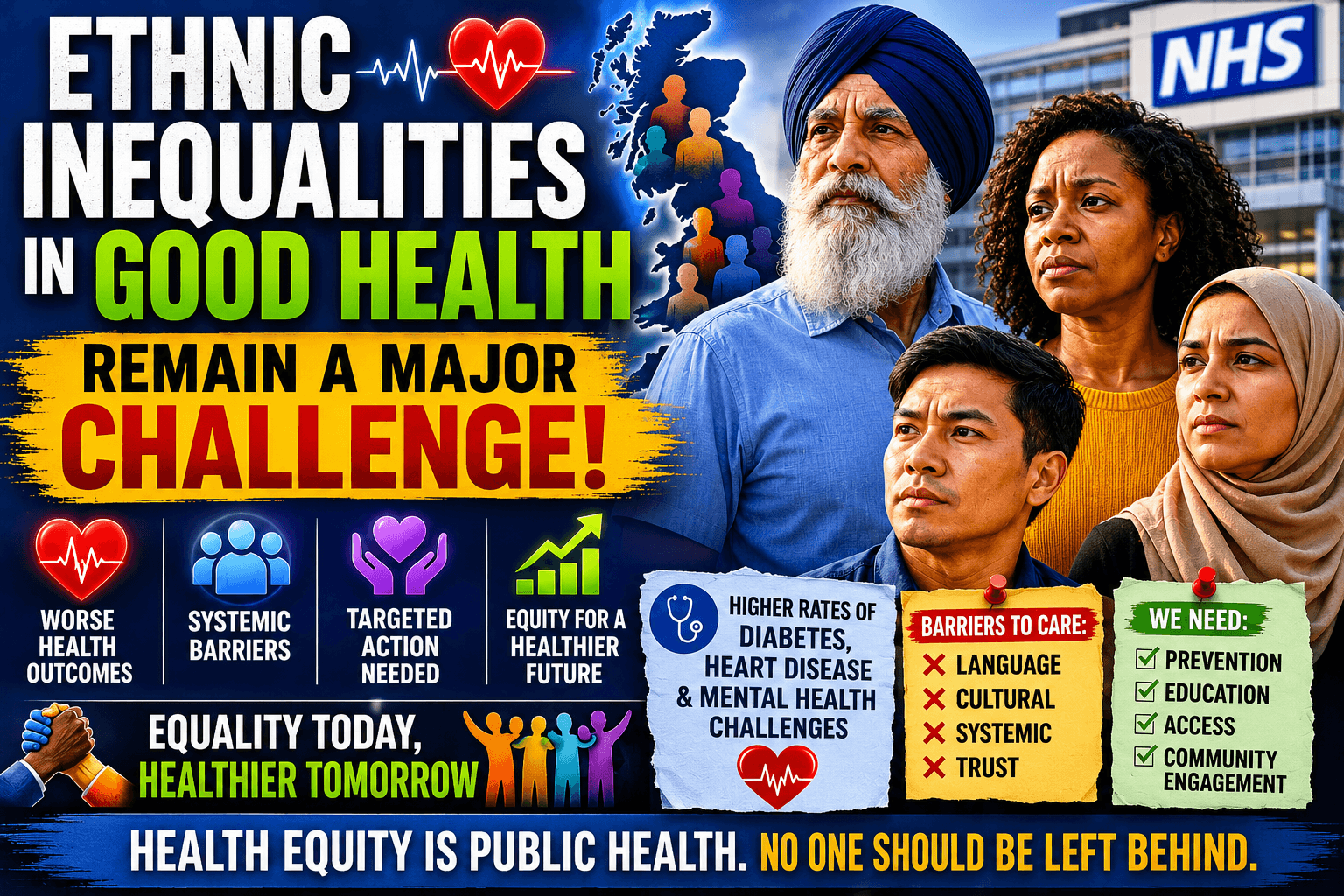
Ethnic Inequalities in Good Health Remain a Major Challenge
Despite advances in healthcare, significant inequalities in health outcomes continue to affect ethnic minority communities across the UK. Research has consistently shown that people from different ethnic backgrounds can experience markedly different health outcomes, life expectancy, access to services, and rates of long-term illness.
These disparities are shaped by a complex combination of social, economic and environmental factors. Housing conditions, employment opportunities, income levels, education, and access to culturally appropriate healthcare all play a role in determining an individual’s chances of living a healthy life.
Many ethnic minority communities are disproportionately affected by conditions such as diabetes, cardiovascular disease and certain mental health challenges. Language barriers, difficulties navigating healthcare systems, and lower levels of trust in public institutions can further widen existing gaps.
The COVID-19 pandemic brought these inequalities into sharp focus. Data revealed that some ethnic minority groups experienced higher rates of infection, hospitalisation and mortality, highlighting longstanding structural issues that extend beyond healthcare alone.
Community organisations have increasingly called for targeted interventions that address the root causes of poor health. These include greater investment in prevention, improved health education, better access to primary care, and stronger engagement with local communities to ensure services reflect diverse needs. Sadly, there is very little new thinking in prevention and health education a considerable volume of this work demonstrate cultural incompetence and therefore failure to make a measurable impact.
Mr. Krishna Sarda, General Secretary of the Indian Workers’ Association (IWA) Southall, emphasised the importance of tackling these disparities, stating: That Neighbourhood health systems are replicating old thinking into new bottles, sadly I fear these will fail to deliver on the stated objectives and this will be another missed opportunity.
His comments reflect growing concern among community leaders that health inequalities cannot be addressed solely through medical treatment. Instead, meaningful progress will require coordinated action across healthcare, housing, employment, education and partnership with those that are impacted by health inequalities. The General Secretary further stated that “we end up being the subjects of much research and comment but very little benefit and cannot control the levers of health that impact negatively on us”
Experts argue that reducing ethnic health inequalities is not only a matter of fairness but also a public health necessity. By ensuring that all communities have equal opportunities to live healthy lives, policymakers can help build a healthier and more resilient society for future generations. A recent report by the Health Foundation.
As the UK continues to confront persistent health disparities, campaigners and community leaders are urging decision-makers to place equity at the centre of health policy. The challenge is substantial, but so too is the opportunity to create a system in which ethnicity is no longer a predictor of health outcomes.
Sadly, we still lack comprehensive, good-quality data that is essential for enabling policy-makers and health care professionals to identify the specific needs of different ethnic minority communities, respond with tailored strategies for addressing inequalities, and track their impact.